Refresh loader

Archive : virtual CTO services

Home > Posts tagged virtual CTO services

Virtual CTO Services and Your Vendor Ecosystem: Full Guide

The Leadership Gap Most Growing Businesses Ignore

Many fast-growing companies hit a frustrating wall. Their product works. Revenue is climbing. The development team is shipping. Yet every technical decision feels risky, slow, or reactive. That gap is a leadership gap — and it is exactly what virtual CTO services are built to fill.

A CTO service provides senior technology leadership without the full-time executive cost. Whether you call it a consulting CTO, a CTO advisory service, or an on-demand CTO consultant, the function is the same: strategic technology leadership that plugs into your business and actually works with the people already there.

💼 Key Stat: Companies that hire a virtual CTO consultant report 40% faster product roadmap delivery and significantly fewer costly architectural mistakes in their first year of engagement.

What Is a Virtual CTO Service?

A virtual CTO service is a fractional or part-time engagement with a senior technology leader. This person does not replace your team. Instead, they lead it strategically. They make architectural decisions, guide vendors, set development standards, and align your technology roadmap with business goals — all without the seven-figure salary of a full-time C-suite hire.

CTO consulting services typically range from a few hours per week to near full-time engagement, depending on the complexity of your technology environment. Startups often start with 10 hours a month. Scale-ups approaching Series B may need 30+ hours weekly.

Virtual CTO Services and Your Vendor Ecosystem: Full Guide

How Virtual CTO Services Integrate With Internal Teams

1. Establishing Trust Before Authority

The first thing a skilled CTO consultant does is listen. They spend the initial weeks conducting technology audits, joining team standups, and reviewing your current codebase, infrastructure, and delivery processes. This phase is critical. Integration fails when a consultant arrives with preformed opinions and imposes change without context.

Good CTO consulting begins with discovery. Only after understanding the existing team’s strengths and frustrations can a virtual CTO earn the authority to lead effectively.

2. Operating as a Force Multiplier, Not a Replacement

Your developers, engineers, and product managers already possess deep domain knowledge. A virtual CTO service amplifies that knowledge by providing direction, prioritization, and architectural guardrails. Think of a consultant CTO as the GPS for your engineering team — they do not drive the car, but they ensure everyone heads in the right direction.

1
Technology Audit — The CTO consultant reviews infrastructure, code quality, security posture, and development practices within the first two weeks.
2
Stakeholder Alignment — They meet with founders, product leads, and team leads to understand business goals and pain points.
3
Roadmap Development — Working collaboratively, they build a 6–12 month technology roadmap that balances delivery speed with technical debt reduction.
4
Embedded Leadership — They join key meetings, mentor senior engineers, and make or ratify key architectural decisions.
5
Ongoing Advisory — As needs evolve, the CTO advisory service scales up or down, providing continuous strategic oversight.

How CTO Consulting Services Work With Vendors

Many growing businesses rely on outsourced development vendors, offshore engineering teams, or specialized technology partners. Managing these relationships is notoriously difficult without experienced technical leadership. This is where CTO consulting services add enormous value.

Vendor Evaluation and Selection

A CTO consultant brings experience evaluating vendor proposals that internal product managers or founders rarely have. They assess not just price but delivery track record, technical capability, communication culture, and alignment with your existing stack. Consequently, businesses make vendor decisions with far less risk.

Setting Vendor Accountability Frameworks

Vendors perform best when expectations are crystal clear. A virtual CTO service creates technical specifications, acceptance criteria, code review standards, and delivery milestones that keep vendors accountable. Furthermore, regular vendor review sessions — led by the CTO consultant — ensure alignment without micromanagement.

🔍 Insight: Businesses using CTO advisory services for vendor management report 35% fewer project delays and significantly better code quality from outsourced teams, according to industry surveys.

Acting as the Technical Bridge

Founders and product managers often struggle to communicate technical requirements to vendors. A consulting CTO bridges that gap fluently. They translate business requirements into technical specifications and translate vendor progress updates back into business language. Both sides feel heard. Projects move faster as a result.

Common Integration Challenges and How to Overcome Them

Challenge Root Cause CTO Consulting Solution
Team resistance to outside leadership Fear of job security or authority conflict Position the CTO as a mentor, not evaluator
Vendor misalignment with internal team Unclear specs and no unified standards CTO creates shared technical standards
Roadmap drift under delivery pressure No senior technical voice in planning CTO advisory validates and prioritizes roadmap
Technical debt accumulating silently No architectural oversight or review CTO institutes code review and audit cycles
Security vulnerabilities post-launch Speed over security in dev decisions CTO embeds security gates into workflow

CTO Advisory Services vs Full-Time CTO: The Trade-offs

A full-time CTO costs between $200,000 and $400,000 annually in salary alone — plus equity, benefits, and recruiting fees. CTO services typically cost a fraction of that, ranging from $5,000 to $25,000 per month depending on engagement depth. For most startups and mid-market businesses, that difference is transformative.

Moreover, a virtual CTO service brings broader experience. A single fractional CTO consultant may have led technology at five or six companies across different industries. That cross-sector perspective is genuinely rare in a single full-time hire.

  • Fractional cost — roughly 20–40% of a full-time CTO salary.
  • Immediate availability — no 3-month hiring process.
  • Scalable engagement — adjust hours as your needs change.
  • Diverse experience — battle-tested across multiple domains.
  • Low commitment risk — contract-based, not equity-heavy.

When Should You Engage CTO Consulting Services?

The right time for a CTO service engagement is earlier than most founders think. Consider engaging a CTO consultant when your product is approaching launch and technical decisions are becoming frequent. Alternatively, consider it when your development team is growing beyond 5 engineers and coordination is becoming difficult.

Additionally, major infrastructure migrations, cloud adoption, AI integration projects, and security audits all benefit from CTO advisory services. These high-stakes moments demand senior technical judgment that most internal teams do not yet possess.

🚀 Best Practice: Engage a virtual CTO service at least 60 days before a major product launch or infrastructure overhaul. Strategic value compounds when there is time to act on recommendations.

Measuring the ROI of CTO Services

Measuring ROI from CTO consulting services requires tracking the right metrics. Reduced deployment failures, shorter sprint cycles, lower vendor dispute rates, improved security audit scores, and faster time-to-market are all quantifiable outcomes. Set baseline metrics before the engagement begins. Then review them quarterly with your consultant CTO to demonstrate value clearly.

Conclusion

Virtual CTO services are no longer a fallback for companies that cannot afford a full-time hire. They are a strategic choice for businesses that value agility, experience, and cost-efficiency simultaneously. A skilled CTO consultant integrates with your team, aligns your vendors, and builds the technical foundation your business needs to scale. The question is not whether you need this kind of leadership — it is how soon you can bring it on board.

Read More:

How vCTO Services De-Risk Your Software Project From Day One
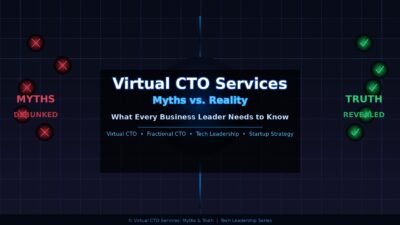
Why Virtual CTO Services Myths Are Costing You Big

Virtual CTO: The Missing Link in Your Tech Team

Why Virtual CTO Services Myths Are Costing You Big

Every growing business hits a technology wall at some point. The systems start to crack. The tech decisions get harder. Yet hiring a full-time CTO can feel out of reach. That is exactly where virtual CTO services come in. However, there is a lot of confusion around what they are and what they actually do.

Myths spread fast. Consequently, many business owners miss out on a service that could transform how they grow. So, let us break down the biggest myths about virtual CTO services and replace them with the truth.

What Are Virtual CTO Services?

A virtual CTO is a senior technology leader who works with your business on a part-time or contract basis. They bring C-suite level expertise without the full-time cost.

They handle tech strategy, vendor management, team oversight, and roadmap planning. Furthermore, they can fill in during leadership gaps or guide a company through a major digital shift.

It is a flexible model. Yet, despite its clear value, misconceptions continue to hold businesses back.

Why Virtual CTO Services Myths Are Costing You Big

Myth 1: Virtual CTO Services Are Just for Big Companies

The Myth

Many founders believe that a CTO, even a virtual one, is only needed by large enterprises with complex tech stacks and hundreds of developers.

The Truth

Small and mid-size businesses actually benefit the most from virtual CTO services. Startups need strategic direction early. Mid-sized firms need structure as they scale.

Moreover, a virtual CTO helps smaller businesses avoid costly tech mistakes before they happen. They provide exactly the kind of senior guidance that most growing companies lack.

Getting expert advice early is far cheaper than fixing bad decisions later. Additionally, it levels the playing field with larger, better-resourced competitors.

Myth 2: A Virtual CTO Is Not as Committed as a Full-Time One

The Myth

The idea is simple: if someone is not in your office every day, they cannot truly be invested in your success.

The Truth

Commitment is measured in outcomes, not office hours. Virtual CTO services are built on results-driven engagement. Their value depends entirely on delivering real impact.

In fact, many virtual CTOs are deeply focused on their clients. They bring a focused, outcome-driven mindset because their reputation depends on it.

Furthermore, a virtual CTO brings fresh perspective from working across multiple industries. That cross-sector insight is something a single in-house hire often cannot provide.

Myth 3: Virtual CTO Services Are Too Expensive

The Myth

Some business owners assume that CTO-level expertise always comes with a full-time salary, benefits, and equity. Consequently, they never even ask about alternatives.

The Truth

Virtual CTO services cost a fraction of a full-time hire. A full-time CTO can cost between $200,000 and $400,000 per year in salary alone. Add benefits, equity, and onboarding costs, and the number climbs fast.

By contrast, virtual CTO services are priced on a part-time or project basis. You pay for what you need, when you need it. Additionally, there are no long-term commitments or HR overhead.

For most growing businesses, the ROI is significant. Better tech decisions mean fewer expensive mistakes. Moreover, faster execution means faster revenue.

Myth 4: A Virtual CTO Cannot Manage Your Tech Team

The Myth

This myth suggests that remote or part-time engagement makes it impossible to lead developers, designers, or tech vendors effectively.

The Truth

Virtual CTOs lead teams every day. Remote team leadership is now a standard and proven model across industries. In fact, many developers actively prefer working with experienced remote leaders.

A skilled virtual CTO knows how to run sprints, set priorities, and create accountability, all without being physically present. They use the same tools and frameworks as any in-house leader.

Furthermore, their focus is on building systems that do not depend on one person being in the room. That kind of scalable leadership structure is actually a competitive advantage.

Myth 5: You Only Need a Virtual CTO If You Have a Tech Product

The Myth

Many non-tech businesses believe that a CTO, virtual or otherwise, only matters if you are building software or running a tech platform.

The Truth

Every modern business is a technology business. Retail, healthcare, finance, hospitality, and education all rely heavily on digital tools, data, and automation.

A virtual CTO helps any business make smarter decisions about the tech that runs their operations. They evaluate software vendors, improve cybersecurity posture, and ensure digital systems support business goals.

Additionally, they help non-tech leaders understand technology well enough to make informed decisions. That clarity is valuable in any industry.

Myth 6: Virtual CTO Services Are a Temporary Fix

The Myth

Some leaders see a virtual CTO as a stopgap. They plan to hire a full-time CTO soon and see the virtual option as a short-term patch.

The Truth

Many businesses use virtual CTO services for years. It is not a stopgap. It is a strategic choice.

For companies that do not need full-time tech leadership, a virtual model offers ongoing senior guidance without the overhead. Furthermore, as needs evolve, the engagement can scale up or down accordingly.

Moreover, a good virtual CTO builds long-term relationships. They learn your business deeply and become a trusted part of your leadership team over time.

Myth 7: Anyone Can Call Themselves a Virtual CTO

The Myth

This concern is real. The market has grown fast. Therefore, some worry that quality is inconsistent and that finding a truly experienced virtual CTO is difficult.

The Truth

Yes, quality varies. However, that is true in every professional services market. The key is knowing what to look for.

A credible virtual CTO has real experience leading technology at a senior level. Look for a track record of building and scaling tech teams, managing complex projects, and driving digital strategy. Additionally, check for strong references and clear communication skills.

The best virtual CTOs often come through trusted networks or reputable agencies. Doing your due diligence pays off significantly.

Myth 8: A Virtual CTO Cannot Understand Your Business Well Enough

The Myth

Some leaders believe that without being embedded in the company full-time, a virtual CTO will never truly grasp the culture, the team, or the business model.

The Truth

Great virtual CTOs are skilled at rapid business immersion. They ask the right questions fast. They learn your goals, your constraints, and your team dynamics quickly.

Moreover, their experience across many businesses actually helps. They bring pattern recognition that a first-time in-house hire may lack. They have seen similar challenges before and know how to navigate them.

Consequently, the onboarding process for a virtual CTO tends to be shorter and more focused than for a full-time executive.

How to Know If Virtual CTO Services Are Right for You

Ask yourself a few honest questions. Does your business need strategic tech leadership but not a full-time hire? Are you making technology decisions without enough confidence? Furthermore, are you scaling fast and need expert oversight without a large investment?

If you answer yes to any of these, virtual CTO services deserve serious consideration. They are not a compromise. They are a smart, deliberate choice.

Additionally, many companies start with a virtual CTO and later transition to a full-time hire once they have the revenue and scale to justify it. The virtual model is an excellent bridge.

What to Look for When Hiring a Virtual CTO

First, look for relevant industry experience. A virtual CTO with background in your sector will ramp up faster and spot risks more quickly.

Second, assess their communication style. A great CTO must translate complex tech concepts for non-technical leaders. Clarity and patience are non-negotiable.

Third, check their network and vendor relationships. Moreover, review how they structure their engagements. Clear deliverables and measurable outcomes are signs of a professional.

Finally, trust your instincts. You need a strategic partner, not just a consultant. The relationship must be built on honesty and mutual respect.

Final Thoughts

Virtual CTO services have come a long way. They are no longer a niche or experimental option. Today, they are a proven, strategic model used by companies of all sizes.

The myths around them are understandable. Any emerging service category faces scepticism. However, the evidence is clear.

A skilled virtual CTO can transform your technology strategy, reduce risk, build stronger teams, and accelerate growth. All without the cost and commitment of a full-time executive hire.

Consequently, the biggest risk is not in trying virtual CTO services. The biggest risk is in letting myths stop you from accessing the expertise your business needs to grow.

Read More:

Virtual CTO: The Missing Link in Your Tech Team

Can a Virtual CTO Replace a Full-Time One: Full Guide

Why Vcto is the Key to Early Stage Tech Stability Full Guide