Refresh loader

Archive : Startup Tech Leadership

Home > Posts tagged Startup Tech Leadership

How vCTO Rescue & Rebuild Struggling Tech Teams: Full Guide

Every failing project has a story. Usually, it starts with a great idea and ends with missed deadlines, burned budgets, and frustrated teams. What changes the outcome is leadership. Specifically, the right technical leadership at the right moment. That is exactly what a virtual CTO — or vCTO — provides.

Unlike a full-time hire, a vCTO brings senior-level strategy on a flexible basis. Furthermore, they often step in during crises, when time is short and stakes are high. Here are five real-world case studies that show how they do it.

Case Study 1: The E-Commerce Startup That Could Not Scale

A direct-to-consumer fashion brand had grown quickly to $4 million in annual revenue. However, their tech stack could not handle it. The website crashed during every sale event. Customer complaints were rising. The founding team had no technical background.

They hired a vCTO on a three-month engagement. Within the first two weeks, the vCTO conducted a full technical audit. The findings were clear: the monolithic architecture was the root cause.

The vCTO prioritized three things. First, they moved the product catalog and checkout to a headless commerce setup. Second, they introduced CDN caching for high-traffic pages. Third, they rebuilt the deployment pipeline with automated load testing baked in.

By month two, site stability improved dramatically. Moreover, their next flash sale processed 40,000 concurrent sessions without a single crash. Revenue from that event alone exceeded $800,000. The vCTO later helped them hire a full-time CTO — with a clear technical roadmap already in place.

How vCTO Rescue & Rebuild Struggling Tech Teams: Full Guide

Case Study 2: The SaaS Company With a Team That Could Not Ship

A B2B SaaS platform had a 12-person engineering team. Despite the headcount, product releases were delayed by months. The CEO was frustrated. The team was demoralized.

Investors were asking hard questions. The vCTO joined as a fractional leader for six months. They identified the problem within the first three weeks. There was no clear ownership model. Every engineer was working on everything. Consequently, nothing got finished.

The vCTO restructured the team into two-person squads, each owning a specific product domain. They introduced a two-week sprint cycle with clear Definition of Done criteria.

Additionally, they eliminated the weekly status meeting and replaced it with async standups via Loom.

Within 90 days, shipping velocity doubled. The team launched three major features that had been stalled for six months. Furthermore, team satisfaction scores jumped significantly, which reduced attrition risk among senior engineers.

Case Study 3: The Healthcare Tech Firm Facing Compliance Collapse

A digital health startup had built a patient data platform without proper HIPAA compliance architecture. They discovered this only when a hospital prospect asked for a compliance audit. The deal — worth $2 million — was at risk.

Their vCTO was brought in with one clear goal: get compliant without destroying the product or the timeline. The vCTO immediately assessed which data flows touched PHI (protected health information) and which did not.

They redesigned the data layer to isolate PHI into an encrypted vault service with strict access controls. Additionally, they implemented audit logging across every PHI access point. A BAA (Business Associate Agreement) framework was established with all third-party vendors.

The entire remediation took eleven weeks. As a result, the startup passed the hospital audit and closed the deal. Furthermore, the new compliance architecture became a sales differentiator with every subsequent enterprise prospect.

Case Study 4: The Agency That Lost a Major Client Due to Tech  Failures

A digital marketing agency had built a proprietary analytics platform for a Fortune 500 retail client. The platform began producing inaccurate data. The client noticed. Trust eroded fast, and the contract renewal was in serious jeopardy.

The agency’s vCTO was brought in three weeks before the renewal meeting. They traced the data accuracy issue to a broken ETL pipeline that had silently been dropping rows for two months. The vCTO built a data validation layer that ran integrity checks at every pipeline stage. They also set up alerting so any future data anomaly would be caught within minutes — not months. Moreover, a root cause report was prepared and presented transparently to the client.

The client appreciated the honesty and the speed of the fix. They renewed the contract and increased the scope by 30%. Consequently, the agency went from nearly losing the client to deepening the relationship.

Case Study 5: The Fintech Startup With a Security Breach Waiting to Happen

A payments-adjacent fintech had built their MVP fast. Unfortunately, they had skipped security reviews entirely. A penetration test, ordered by a new investor, found critical vulnerabilities: exposed API keys in public GitHub repos, no rate limiting on auth endpoints, and unencrypted sensitive data in transit.

The vCTO stepped in with a 30-60-90 day remediation plan. In the first 30 days, they rotated all exposed credentials, set up secret management via Vault, and patched the authentication endpoints.

In days 31 to 60, they rebuilt the data encryption layer and implemented TLS everywhere. Additionally, they ran a developer security training session to prevent future misconfigurations.

By day 90, a follow-up pen test came back clean. The investor released the next funding tranche. Furthermore, the startup now had a security posture that matched companies twice their size and budget.

What These Case Studies Have in Common

Each of these situations was different in industry, team size, and problem type. However, several patterns appear across all five.

Speed of diagnosis matters most. In every case, the vCTO spent the first week listening and auditing — not implementing. This upfront clarity prevented wasted effort downstream. Communication was treated as a technical skill. The vCTOs in these cases were as skilled at translating technical issues for boards and clients as they were at solving the underlying code problems.

Sustainable fixes outperformed quick patches. Each vCTO left behind systems, processes, and documentation that the internal team could maintain and build on. The goal was always to work themselves out of a job.

When Should You Bring in a vCTO?

These case studies reveal clear trigger points when a vCTO engagement makes sense. Your team is shipping slowly despite adequate headcount. A vCTO can diagnose whether the issue is process, prioritization, or technical debt.

You are preparing for a fundraise or due diligence process. Investors scrutinize architecture, scalability, and security. A vCTO can prepare your tech for that examination.

You are about to close a major enterprise deal. Enterprise buyers often demand technical credibility. A vCTO can lead those conversations and prepare the team for client-side audits.

Your CTO just left. Rather than rushing into a hire, a vCTO can maintain strategic direction while you take time to find the right permanent leader.

Final Thoughts

The best vCTOs do not just fix problems. They build the capacity for teams to prevent the same problems from recurring.

These case studies show that with the right technical leadership, even deeply troubled projects can be turned around — often faster than anyone expected.

If your project is struggling, the question is not whether you need senior technical leadership. The question is how quickly you can get it.

Read More:

How WIP Audits Help vCTOs Lead Teams Better

Virtual CTO Tactics for Better Product Quality

Why Regular WIP Reviews With vCTO Save Project From Disaster

Why Virtual CTO Services Myths Are Costing You Big

Every growing business hits a technology wall at some point. The systems start to crack. The tech decisions get harder. Yet hiring a full-time CTO can feel out of reach. That is exactly where virtual CTO services come in. However, there is a lot of confusion around what they are and what they actually do.

Myths spread fast. Consequently, many business owners miss out on a service that could transform how they grow. So, let us break down the biggest myths about virtual CTO services and replace them with the truth.

What Are Virtual CTO Services?

A virtual CTO is a senior technology leader who works with your business on a part-time or contract basis. They bring C-suite level expertise without the full-time cost.

They handle tech strategy, vendor management, team oversight, and roadmap planning. Furthermore, they can fill in during leadership gaps or guide a company through a major digital shift.

It is a flexible model. Yet, despite its clear value, misconceptions continue to hold businesses back.

Why Virtual CTO Services Myths Are Costing You Big

Myth 1: Virtual CTO Services Are Just for Big Companies

The Myth

Many founders believe that a CTO, even a virtual one, is only needed by large enterprises with complex tech stacks and hundreds of developers.

The Truth

Small and mid-size businesses actually benefit the most from virtual CTO services. Startups need strategic direction early. Mid-sized firms need structure as they scale.

Moreover, a virtual CTO helps smaller businesses avoid costly tech mistakes before they happen. They provide exactly the kind of senior guidance that most growing companies lack.

Getting expert advice early is far cheaper than fixing bad decisions later. Additionally, it levels the playing field with larger, better-resourced competitors.

Myth 2: A Virtual CTO Is Not as Committed as a Full-Time One

The Myth

The idea is simple: if someone is not in your office every day, they cannot truly be invested in your success.

The Truth

Commitment is measured in outcomes, not office hours. Virtual CTO services are built on results-driven engagement. Their value depends entirely on delivering real impact.

In fact, many virtual CTOs are deeply focused on their clients. They bring a focused, outcome-driven mindset because their reputation depends on it.

Furthermore, a virtual CTO brings fresh perspective from working across multiple industries. That cross-sector insight is something a single in-house hire often cannot provide.

Myth 3: Virtual CTO Services Are Too Expensive

The Myth

Some business owners assume that CTO-level expertise always comes with a full-time salary, benefits, and equity. Consequently, they never even ask about alternatives.

The Truth

Virtual CTO services cost a fraction of a full-time hire. A full-time CTO can cost between $200,000 and $400,000 per year in salary alone. Add benefits, equity, and onboarding costs, and the number climbs fast.

By contrast, virtual CTO services are priced on a part-time or project basis. You pay for what you need, when you need it. Additionally, there are no long-term commitments or HR overhead.

For most growing businesses, the ROI is significant. Better tech decisions mean fewer expensive mistakes. Moreover, faster execution means faster revenue.

Myth 4: A Virtual CTO Cannot Manage Your Tech Team

The Myth

This myth suggests that remote or part-time engagement makes it impossible to lead developers, designers, or tech vendors effectively.

The Truth

Virtual CTOs lead teams every day. Remote team leadership is now a standard and proven model across industries. In fact, many developers actively prefer working with experienced remote leaders.

A skilled virtual CTO knows how to run sprints, set priorities, and create accountability, all without being physically present. They use the same tools and frameworks as any in-house leader.

Furthermore, their focus is on building systems that do not depend on one person being in the room. That kind of scalable leadership structure is actually a competitive advantage.

Myth 5: You Only Need a Virtual CTO If You Have a Tech Product

The Myth

Many non-tech businesses believe that a CTO, virtual or otherwise, only matters if you are building software or running a tech platform.

The Truth

Every modern business is a technology business. Retail, healthcare, finance, hospitality, and education all rely heavily on digital tools, data, and automation.

A virtual CTO helps any business make smarter decisions about the tech that runs their operations. They evaluate software vendors, improve cybersecurity posture, and ensure digital systems support business goals.

Additionally, they help non-tech leaders understand technology well enough to make informed decisions. That clarity is valuable in any industry.

Myth 6: Virtual CTO Services Are a Temporary Fix

The Myth

Some leaders see a virtual CTO as a stopgap. They plan to hire a full-time CTO soon and see the virtual option as a short-term patch.

The Truth

Many businesses use virtual CTO services for years. It is not a stopgap. It is a strategic choice.

For companies that do not need full-time tech leadership, a virtual model offers ongoing senior guidance without the overhead. Furthermore, as needs evolve, the engagement can scale up or down accordingly.

Moreover, a good virtual CTO builds long-term relationships. They learn your business deeply and become a trusted part of your leadership team over time.

Myth 7: Anyone Can Call Themselves a Virtual CTO

The Myth

This concern is real. The market has grown fast. Therefore, some worry that quality is inconsistent and that finding a truly experienced virtual CTO is difficult.

The Truth

Yes, quality varies. However, that is true in every professional services market. The key is knowing what to look for.

A credible virtual CTO has real experience leading technology at a senior level. Look for a track record of building and scaling tech teams, managing complex projects, and driving digital strategy. Additionally, check for strong references and clear communication skills.

The best virtual CTOs often come through trusted networks or reputable agencies. Doing your due diligence pays off significantly.

Myth 8: A Virtual CTO Cannot Understand Your Business Well Enough

The Myth

Some leaders believe that without being embedded in the company full-time, a virtual CTO will never truly grasp the culture, the team, or the business model.

The Truth

Great virtual CTOs are skilled at rapid business immersion. They ask the right questions fast. They learn your goals, your constraints, and your team dynamics quickly.

Moreover, their experience across many businesses actually helps. They bring pattern recognition that a first-time in-house hire may lack. They have seen similar challenges before and know how to navigate them.

Consequently, the onboarding process for a virtual CTO tends to be shorter and more focused than for a full-time executive.

How to Know If Virtual CTO Services Are Right for You

Ask yourself a few honest questions. Does your business need strategic tech leadership but not a full-time hire? Are you making technology decisions without enough confidence? Furthermore, are you scaling fast and need expert oversight without a large investment?

If you answer yes to any of these, virtual CTO services deserve serious consideration. They are not a compromise. They are a smart, deliberate choice.

Additionally, many companies start with a virtual CTO and later transition to a full-time hire once they have the revenue and scale to justify it. The virtual model is an excellent bridge.

What to Look for When Hiring a Virtual CTO

First, look for relevant industry experience. A virtual CTO with background in your sector will ramp up faster and spot risks more quickly.

Second, assess their communication style. A great CTO must translate complex tech concepts for non-technical leaders. Clarity and patience are non-negotiable.

Third, check their network and vendor relationships. Moreover, review how they structure their engagements. Clear deliverables and measurable outcomes are signs of a professional.

Finally, trust your instincts. You need a strategic partner, not just a consultant. The relationship must be built on honesty and mutual respect.

Final Thoughts

Virtual CTO services have come a long way. They are no longer a niche or experimental option. Today, they are a proven, strategic model used by companies of all sizes.

The myths around them are understandable. Any emerging service category faces scepticism. However, the evidence is clear.

A skilled virtual CTO can transform your technology strategy, reduce risk, build stronger teams, and accelerate growth. All without the cost and commitment of a full-time executive hire.

Consequently, the biggest risk is not in trying virtual CTO services. The biggest risk is in letting myths stop you from accessing the expertise your business needs to grow.

Read More:

Virtual CTO: The Missing Link in Your Tech Team

Can a Virtual CTO Replace a Full-Time One: Full Guide

Why Vcto is the Key to Early Stage Tech Stability Full Guide

Virtual CTO: The Missing Link in Your Tech Team

Bringing in a Virtual CTO sounds great on paper. Senior tech leadership, no full-time salary, flexible engagement. Perfect, right?

But then a nagging question creeps in. “Will this person actually work with my team? What about our agency partner? Will they clash with our developers or confuse our vendors?”

These are fair concerns. The good news is, they are also largely unfounded — provided you choose the right Virtual CTO and set things up well. In fact, when done correctly, a Virtual CTO doesn’t just fit into your existing structure. They make it work better.

So, let’s walk through exactly how this integration happens in practice.

Virtual CTO: The Missing Link in Your Tech Team


Understanding the Virtual CTO’s Role in Your Ecosystem

Before diving into specifics, it helps to understand what a Virtual CTO is — and is not — in your organisation.

A Virtual CTO (also called a fractional CTO or CTO-as-a-Service) is an experienced technology leader who joins your company part-time or on a contract basis. They are not a project manager. They are not a developer. And they are certainly not there to replace your existing team.

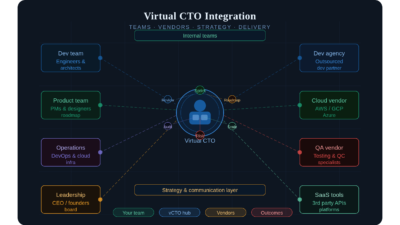
Instead, they sit above the day-to-day delivery layer. They provide strategic direction, technical oversight, and leadership continuity — without disrupting the people already doing the work. Think of them as the conductor of an orchestra, not the musician who replaces another. Everyone plays their part; the Virtual CTO simply makes sure the music comes together.


Working With Your In-House Development Team

For many companies, the biggest concern is how a Virtual CTO will interact with internal developers. Will there be tension? Will engineers feel micromanaged?

The short answer is no — at least not if the Virtual CTO approaches the role correctly.

A seasoned Virtual CTO understands that their job is to enable, not interfere. From day one, they typically begin with a listening phase. They meet the team and review existing code, architecture, and processes. They understand how things work before suggesting changes.

After that initial discovery period, they focus on a handful of high-leverage activities. Code reviews and architecture guidance happen at a strategic level, not a granular one. Sprint planning and technical roadmaps get cleaner, more structured. Engineers get clearer priorities and fewer conflicting instructions from the top.

Importantly, a good Virtual CTO also becomes a career resource for your developers. They mentor senior engineers, help resolve technical disputes, and create a healthier engineering culture overall. Rather than creating tension, they typically earn respect — because they bring experience the team can genuinely learn from.


Integrating With Outsourced or Agency Development Partners

Many startups and growing businesses rely on an external development agency or offshore dev team. This is where Virtual CTO integration becomes especially valuable.

Without a tech leader in-house, founders often struggle to manage agency relationships effectively. They can’t fully assess the quality of work being delivered. They don’t know if the architecture the agency proposes is truly in their long-term interest. And they lack the authority to push back when timelines slip or decisions feel wrong.

A Virtual CTO changes that dynamic entirely.

First, they serve as a technical bridge between you and the agency. They translate business requirements into clear technical briefs and review deliverables before sign-off. They hold the agency accountable to standards — quality, security, documentation, and code maintainability.

Second, they protect you from vendor lock-in. Some agencies deliberately build in dependencies that make switching costly. A Virtual CTO spots these practices early and insists on clean, portable code and proper knowledge transfer. That alone can save you enormous pain down the road.

Third, they manage the relationship professionally. Instead of chaotic back-and-forth between founders and agency project managers, there is a single senior technical point of contact. Communication sharpens. Accountability improves. Delivery accelerates.


Collaborating With Cloud and SaaS Vendors

Beyond development teams, most modern businesses rely on a stack of third-party vendors — cloud providers like AWS, Google Cloud, or Azure, as well as SaaS platforms, analytics tools, and API integrations.

Managing these vendors strategically is a genuine skill. Without proper oversight, companies over-provision cloud resources, sign long-term contracts they outgrow, and accumulate tool sprawl that costs far more than it delivers.

A Virtual CTO takes ownership of your vendor landscape. They audit what you are currently using and what it costs and identify consolidation opportunities. They negotiate with vendors on your behalf — or advise you on how to do so effectively and ensure your cloud architecture is optimised for cost and performance, not just functionality.

Moreover, when evaluating new tools or platforms, they serve as your technical filter. Instead of relying on a vendor’s sales pitch, you have an expert who can assess whether a tool genuinely fits your stack and your growth stage. That alone prevents a lot of expensive mistakes.


Communicating With Leadership and the Board

One often-overlooked integration point is the relationship between your tech function and your senior leadership team. This gap causes real problems in many organisations.

Technical teams speak in code, frameworks, and infrastructure concepts. Founders, investors, and board members speak in strategy, revenue, and risk. Typically, nobody is translating effectively between these two worlds.

A Virtual CTO fills that gap naturally. They distil complex technical realities into clear, business-focused language and present technology updates in board meetings, investor due diligence sessions, and strategy reviews — in a way that actually lands. They help leadership make better decisions by giving them the technical context they need, without overwhelming them.

Additionally, when a fundraise requires technical documentation or a data room needs an architecture overview, the Virtual CTO handles it. This credibility boost is something many founders underestimate until they actually experience it.


Practical Integration: How the First 30 Days Typically Look

It helps to understand what the onboarding process actually looks like in practice. Here is a typical first-month pattern for a Virtual CTO integration.

During the first week, they focus on discovery. That means reviewing the existing codebase, infrastructure, and documentation. It also means meeting every key stakeholder — developers, designers, operations leads, and founders. No recommendations are made yet. Listening comes first.

By week two, they start forming a view. They identify the three to five most pressing technical risks or gaps. They also map out existing vendor relationships and assess which are working well and which are not.

During weeks three and four, they begin adding value actively. A revised technical roadmap takes shape. Communication processes between the team and leadership get structured. Any immediate blockers — whether a pending architectural decision or a vendor contract renewal — get addressed with guidance.

By the end of the first month, integration is typically smooth. The team has seen how the Virtual CTO operates. Trust begins building. Founders feel more confident. And the technical function starts running with noticeably more clarity.


Common Myths About Virtual CTO Integration

A few misconceptions are worth addressing directly.

“They won’t understand our business fast enough.” A good Virtual CTO has done this many times. They know how to get up to speed quickly and ask the right questions early.

“Our team will resist an outsider.” Resistance usually fades fast when the team sees the Virtual CTO is there to support, not replace or criticise.

“We can’t afford to brief someone new.” The onboarding investment is genuinely small compared to the value delivered. Most teams report feeling relief — not burden — within the first few weeks.


Final Thoughts

A Virtual CTO is not a disruption to your team or your vendor relationships. Done right, they are the glue that makes all of it work better.

Your developers get clearer leadership and agency partners get better accountability. Your vendors get properly managed and leadership team gets a trusted technical voice.

Integration does not have to be complicated. It just has to be intentional.

And when it is, a Virtual CTO quickly stops feeling like an outsider. They become exactly what every growing tech business needs — a steady, experienced hand guiding the whole machine forward.

Read More:

Can a Virtual CTO Replace a Full-Time One: Full Guide

Why Vcto is the Key to Early Stage Tech Stability Full Guide

Common Vcto Myths and the Strategic Truths Behind Them