You built your MVP. Congrats — that’s genuinely hard work. But now, a bigger challenge appears. How do you take that early-stage product and turn it into something truly scalable? How do you make the right tech decisions without burning your runway? And how do you do all of this without a full-time CTO eating up half your salary budget? The answer, for a growing number of startups, is simple. They hire a Virtual CTO.
In this post, we’ll break down exactly what a Virtual CTO does, why they matter at the MVP stage, and how they help you scale without the chaos.
First, What Exactly Is a Virtual CTO?
Let’s clear this up right away.
A Virtual CTO — also called a CTO-as-a-Service or fractional CTO — is an experienced tech leader who works with your company on a part-time or contract basis. They’re not a full-time hire. Instead, they bring senior-level expertise exactly when and where you need it.
Think of them as your on-demand technology co-founder. They guide your tech strategy, review your architecture, manage your dev team, and help you make critical decisions — all without the overhead of a permanent C-suite hire.
For early-stage startups, this model is incredibly powerful. And here’s why.
The Problem With Scaling an MVP Alone
Building an MVP is one thing. Scaling it is a completely different game.
When you’re in the MVP phase, speed is everything. You cut corners, ship fast and validate quickly. That approach is exactly right for early-stage testing.
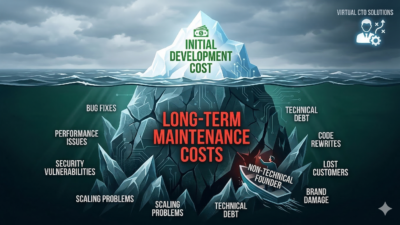
But then, something shifts. Users come in. Traffic grows. Features stack up. And suddenly, the quick fixes and shortcuts you relied on early on start breaking things. Your tech debt grows and system slows down. Your team struggles to keep up.
At this point, most founders face a tough choice. Do they hire a full-time CTO and spend $150,000–$250,000 a year on salary alone? Or do they muddle through, making costly tech decisions without the right expertise?
Neither option is ideal. And that’s exactly the gap a Virtual CTO fills.
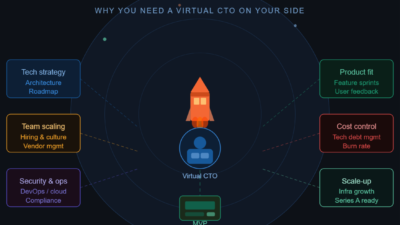
What a Virtual CTO Actually Does for Your Startup
So, concretely, what does a Virtual CTO bring to the table? Quite a lot, actually.
They build a clear tech roadmap.
First and foremost, a Virtual CTO creates structure. They assess where your product is today. Then, they map out where it needs to go. Moreover, they help you prioritize features based on user needs, market demands, and technical feasibility — not just gut feel.
Without this roadmap, startups tend to drift. They build what feels urgent, not what’s actually important. As a result, they waste months and money on the wrong things.
They fix your architecture before it breaks you.
Early MVPs are rarely built to scale. That’s fine — they’re not supposed to be. However, as you grow, poor architecture becomes a serious liability.
A Virtual CTO audits your tech stack and spots the weak points. They redesign systems for scalability. They help you migrate from monolithic structures to microservices if needed. And they do all of this proactively — before things break in production.
They manage and mentor your dev team.
Great developers don’t always make great leaders. And as your team grows, leadership becomes just as important as code quality.
A Virtual CTO steps in to fill that gap. They run technical reviews and set coding standards. They help resolve conflicts within the team. Furthermore, they mentor junior developers, which means your overall team quality improves over time.
They help you choose the right tools and vendors.
Every startup faces a flood of technology choices. Which cloud provider should you use? Should you build or buy? Which third-party APIs make sense for your stack? These decisions seem small, but they compound significantly over time.
A Virtual CTO has seen these decisions play out dozens of times. Therefore, they guide you toward choices that are cost-effective, scalable, and aligned with your long-term goals.
They handle investor and board-level tech conversations.
If you’re raising a Series A or preparing for due diligence, your tech story matters enormously. Investors want to know that your architecture can handle growth. They want to understand your security posture. They want confidence in your engineering team.
A Virtual CTO can speak that language fluently. They prepare tech documentation, answer investor questions, and give your startup serious credibility in the room.
Virtual CTO vs Full-Time CTO: Which Is Right for You?
This is the question most founders eventually ask. So, let’s tackle it directly.
A full-time CTO makes sense when your product is live and growing fast, your engineering team exceeds 15–20 people, and you need daily, hands-on tech leadership. Additionally, it makes sense when you have the budget and the need for a dedicated leader in the C-suite.
On the other hand, a Virtual CTO is the better fit when you’re still validating your product or scaling from MVP. It also makes sense when your engineering team is small — typically under 10 people. Moreover, it’s ideal when you need strategic guidance but not daily management, or when you want to preserve budget for product and hiring.
For most startups between pre-seed and Series A, a Virtual CTO offers dramatically better ROI. You get the expertise without the full-time cost. And you can scale the engagement up or down as your needs change.
Key Signs You Need a Virtual CTO Right Now
Still not sure if it’s the right time? Look for these signals.
Your dev team is making architecture decisions you don’t fully understand. Your product is slowing down under growing user load. You’re about to raise funding and need to sharpen your tech narrative. You’re hiring developers but have no senior leader to set standards. Your MVP has launched but you’re not sure what to build next.
If any of these sound familiar, it’s time to bring in a Virtual CTO. Waiting too long is one of the costliest mistakes a startup can make.
The Real Cost of Not Having Tech Leadership
Let’s talk numbers for a moment.
Technical debt is expensive. According to industry research, poor tech decisions made early can cost 3–5x more to fix later. Furthermore, a single bad architecture choice — like choosing the wrong database or building a non-scalable microservice structure — can delay your product roadmap by months.
On top of that, hiring the wrong developers without proper oversight costs startups an average of 1.5x their annual salary in lost productivity and rehiring. And a security breach caused by poor oversight? That can end a startup entirely.
The math is straightforward. A Virtual CTO typically costs a fraction of a full-time hire. Yet, they prevent mistakes that cost multiples of that amount. It’s not a cost — it’s a return on investment.
How to Find the Right Virtual CTO for Your Startup
Not all Virtual CTOs are created equal. So, it’s worth knowing what to look for.
First, look for domain experience. A Virtual CTO who has worked in fintech, for example, will understand your compliance landscape better than a generalist.
Second, check for startup experience specifically. Building and scaling startups is very different from enterprise IT. You need someone who thinks fast and moves lean.
Third, ask for references. Talk to founders they’ve worked with before. Find out how they handled conflict, pressure, and rapid change.
Finally, ensure cultural fit. A Virtual CTO is a leadership partner. They need to mesh with your team, your values, and your pace.
Final Thoughts
Going from MVP to scalable product is one of the hardest transitions in the startup journey. There are so many decisions to make. So many ways to go wrong. And so much at stake.
That’s exactly why you shouldn’t do it alone.
A Virtual CTO brings the experience, structure, and clarity you need to move fast — without breaking things. They help you build smarter, scale faster, and grow with confidence.
Because the best startups don’t just build great products. They build great tech foundations. And that starts with having the right leader in the room.
Ready to scale? It might be time to make your first virtual hire.
Found this useful? Share it with a founder who’s still figuring out their tech strategy.
Read More:
Why Vcto is the Key to Early Stage Tech Stability Full Guide